Inventory Planning in Retail: How One Premium Retail Brand Turned Manual Inventory Planning into a 15-Minute Process
Manual spreadsheets were slowing down inventory planning. See how one premium retailer used AI to automate allocation, replenishment, and consolidation while improving inventory productivity and customer availability.
Retail Inventory Planning: Why It Matters More Than Ever
For premium retailers, inventory isn't just about keeping shelves full. It's about making sure the right products are available in the right stores at the right time.
When customers walk into a store expecting to find a particular style in their size and leave empty-handed, the impact goes beyond a single lost sale. It affects customer loyalty, repeat purchases, and overall brand perception.
One premium lifestyle retailer was preparing for the next phase of their growth. While demand was healthy, they knew their inventory planning processes needed to improve if they wanted to maintain high product availability and deliver a consistent customer experience across every store.
(Customer details have been anonymized for confidentiality.)
The Biggest Challenges in Retail Inventory Planning
Getting inventory to the right stores at the right time is the biggest challenge that physical retailers face.
Some stores regularly ran out of popular products while others continued holding slow-moving inventory. Store managers frequently requested stock transfers, customers were asked to wait for products to arrive from other locations, and advance orders became increasingly common to avoid losing sales.
Generic allocations across every store simply weren't working. Each location served a different customer base with different sales patterns and thus had different inventory requirements. The planning team knew they needed a smarter approach, but their existing processes made that difficult.
How Manual Inventory Planning Slowed Retail Operations
Inventory planning relied almost entirely on spreadsheets. The workflow revolved around three critical planning activities.
New Collection Allocation
Every new collection launch began with planners manually identifying similar historical products based on attributes such as product category, fabric, color, size, price, construction, and design. For every SKU, planners would identify existing similar products and review their rate of sales across stores for the first 7 days before deciding how much inventory each location should receive.
This entire exercise happened in Excel.
Downloading reports, running VLOOKUPs, comparing historical styles, and preparing allocation plans typically took 3-4 hours per category for every collection launch.
Replenishment Planning
Once products reached stores, planners reviewed sales every two days to identify stores selling faster than expected. If replenishment decisions weren't made quickly, high-performing stores risked running out of stock while inventory remained available elsewhere. After the first two weeks, replenishment reviews continued every five days throughout the selling period.
The process depended on manually downloading fresh reports, comparing inventory against sales, identifying replenishment gaps, and preparing warehouse instructions.
Inventory Consolidation
As collections matured, another challenge emerged.
Warehouse inventory was often exhausted while stock remained scattered across stores in incomplete size runs. Planners had to identify which stores should continue carrying older inventory, which stores should transfer stock out, and where complete size sets could still generate sales.
Creating an optimized consolidation plan required extensive analysis, followed by weeks of coordinating transfer orders between stores. From planning through execution, the entire process often stretched to nearly two weeks.
These manual workflows made it difficult to respond quickly to changing demand.
As a result, the retailer couldn't consistently account for:
- Lost sales caused by stock-outs.
- Inventory sitting in low-performing stores.
- Higher replenishment costs caused by inaccurate demand planning.
- Hours spent preparing spreadsheets instead of making planning decisions.
- Excess inventory that could have been sold earlier.
How AI Improved Inventory Planning with WhoDB
Instead of replacing the retailer's planning methodology, Clidey built technology around it.
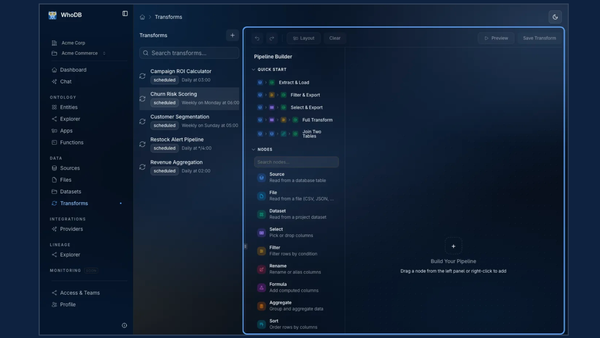
Using its AI-powered data platform WhoDB, we connected directly to the retailer's existing data and designed planning tools that matched the way their merchandising team already worked.
The goal was to remove repetitive manual work while helping planners make faster, better-informed decisions. Three planning workflows were automated.
New Collection Allocation
Planners simply uploaded an Excel file containing new products, product attributes, purchase quantities, and pricing.
Within minutes, the platform analyzed every SKU against its three most similar historical products and generated an initial allocation plan.
The allocation logic reflected the retailer's own planning rules, including:
- 10-day demand forecasting for outstation stores.
- 7-day rate-of-sale planning for local stores where replenishment was faster.
- Prioritizing higher sales velocity stores before lower-performing locations.
- Maintaining full size sets for top-performing stores while optimizing size availability across other store tiers.
- Respecting each store's display and storage capacity before allocating inventory.
The recommendation became the planner's first draft instead of starting from a blank spreadsheet.
Replenishment Tool
Rather than manually reviewing inventory reports every morning, planners received real-time visibility into products approaching critical stock levels.
The platform continuously identified replenishment opportunities, prioritized stores needing immediate action, and generated alerts before availability became a customer problem.
Instead of spending hours finding replenishment gaps, planners could immediately focus on the actions that mattered.
Consolidation Tool
Inventory consolidation became one of the biggest opportunities for automation.
The platform analyzed inventory positions after 30, 45, and 60 days of selling. It identified slow-moving inventory, recommended optimized store-to-store transfers, and suggested where remaining inventory had the highest probability of selling through.
What previously depended on manual discussions between planners and store managers became a structured, data-backed recommendation generated automatically.
From Manual Planning to AI-Assisted Inventory Decisions
Rather than getting bogged down in spreadsheets and manual analysis, planners were able to focus on reviewing recommendations and making commercial decisions where their expertise mattered most. By shifting the operational heavy lifting to AI, the team saw immediate improvements in efficiency:
- From reactive to proactive: Instead of manually identifying replenishment opportunities, planners worked from a stream of prioritized alerts.
- Faster inventory optimization: Rather than spending weeks analyzing consolidation opportunities, they received optimized transfer recommendations from the start.
- More time for better decisions: With routine planning work automated, planners could make decisions significantly faster while remaining fully aligned with the retailer's existing planning philosophy.
Business Results of Smarter Inventory Planning
By moving planning away from spreadsheets and into a real-time, AI-powered workflow, the retailer transformed how inventory decisions were made across the business.
Allocation plans that once took 3–4 hours per category could now be completed in 10–15 minutes, with every new SKU automatically compared against similar historical products and recommendations prioritized using demand forecasts, sales velocity, store grading, and size-set availability.
Rather than relying on scheduled spreadsheet reviews, planners worked from live replenishment alerts, identified slow-moving inventory earlier, and received optimized consolidation and inter-store transfer recommendations backed by real-time sales and inventory data.
The impact extended well beyond saving time. Teams were able to improve product availability, reduce lost sales from stock-outs, respond faster to changing customer demand, increase inventory productivity, and improve seasonal sell-through by moving stock where it was needed most.
Most importantly, the retailer achieved all of this without changing how planners preferred to work. Instead of replacing their expertise, the platform amplified it—eliminating manual effort, accelerating decision-making, and giving teams more time to focus on the commercial decisions that drive the business forward.