Self-Hosted vs. Cloud Data Warehouses: Which One Actually Fits Your Team?
A plain comparison of self-hosted vs. cloud data warehouses across cost, control, compliance, and scale, so you can match the model to your team's actual constraints instead of the industry default.

Every data team eventually has this argument. Someone wants to move everything into Snowflake or BigQuery and stop worrying about infrastructure. Someone else wants to keep the data in-house, on hardware the company controls, for reasons that usually involve the words "compliance" or "cost." Both sides have a point. The self-hosted vs cloud data warehouse decision comes down to which set of trade-offs your team can actually live with.
This post covers the real differences in cost, control, and compliance, then where a platform like WhoDB fits into either choice.
What "Self-Hosted" and "Cloud" Actually Mean
A self-hosted data warehouse runs on infrastructure your organization controls: your own servers, VPC, or private data center. Your team owns setup, patching, backups, and scaling decisions.
A cloud data warehouse runs on a provider's infrastructure, such as Snowflake, BigQuery, or Redshift. The provider handles most of the operational work, including availability and maintenance. You pay for what you use, usually through some mix of storage and compute.
Where the servers physically sit matters less than who's responsible for keeping the system running, and who controls what happens to the data along the way.
Cost, Control, and Scale
Cloud data warehouses separate storage from compute and charge by usage, which works well for spiky workloads but gets expensive fast when a team scans more data than it needs or leaves compute running idle. Self-hosted flips that: you pay for infrastructure up front regardless of use, but the bill doesn't move when demand spikes, which is often the whole reason teams choose it.
Self-hosted also keeps data within infrastructure you control, which matters for healthcare, finance, government, and anyone under strict data residency rules. Cloud providers have closed some of that gap with residency controls and customer-managed keys, though options vary by provider. Scaling follows the same split: cloud adds and removes compute on demand, self-hosted requires planning ahead in exchange for costs that don't move unexpectedly.
Self-hosted tends to fit teams with steady workloads and existing infrastructure staff. Cloud tends to fit teams that want to move fast without taking on that work. TechTarget and ClickHouse both cover this trade-off in more depth if you want to go deeper.
Self-Hosted vs. Cloud Data Warehouse: A Quick Comparison
| Category | Self-Hosted | Cloud |
|---|---|---|
| Who manages infrastructure | Your team | The provider |
| Cost model | Predictable, upfront | Usage-based, can vary |
| Data location | Your infrastructure | Provider's infrastructure |
| Compliance | Direct control | Depends on provider |
| Scaling | Planned and managed by your team | Elastic, on demand |
| Setup speed | More configuration up front | Faster to get started |
Table1: Self-hosted vs cloud data warehouse comparison table covering cost, control, scaling, and compliance.
Where WhoDB Fits In
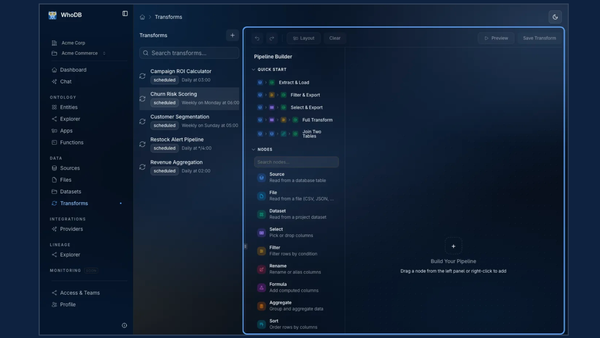
WhoDB doesn't require you to move your existing data into a new warehouse before you can work with it. It connects to databases, warehouses, and cloud services in place, whether that's PostgreSQL, Snowflake, BigQuery, or Databricks, and works whether your environment is self-hosted, cloud, or both. WhoDB itself is available as WhoDB Cloud or as a Managed Private deployment inside your own environment, so the warehouse decision and the tooling decision don't have to be the same choice.
Frequently Asked Questions
Is self-hosted cheaper than cloud?
It depends on usage. Self-hosted gives more predictable costs for steady workloads; cloud works better for workloads that change a lot. Total cost includes staff and maintenance too, not just infrastructure.
Which is easier for compliance?
Self-hosted gives direct control over infrastructure and data location, which helps with residency requirements. Cloud providers can meet many compliance standards too, but check the certifications for your specific provider.
Picking Between Self-Hosted and Cloud
It comes down to how your team works, how predictable the workload is, what infrastructure you already have, and what your compliance requirements demand. Cloud removes enough operational work to justify the usage-based model for some teams. For others, direct control and predictable costs make self-hosted the better fit. Either way, make sure the tools around your data can work with whichever environment you choose.
Related reading: What Data Lineage Actually Means and Why We Built WhoDB's Visual Data Pipeline Builder.