What Is a Semantic Ontology and Why Should Non-Technical Teams Care?
A semantic ontology gives your data shared, plain-language meaning. Learn what it is, how it connects business concepts, and why non-technical teams should care.


A semantic ontology is a shared map of what your business terms mean and how they connect. It gives people and tools a consistent understanding of terms such as "customer," "revenue," and "active user."
When teams disagree on the meaning of a term, a semantic ontology provides a shared definition. You don't need to write code to benefit from one.
Think of it as a company dictionary that also understands relationships. A normal glossary explains what a "customer" is. A semantic ontology goes further. It shows that a customer places orders, an order contains products, and a product belongs to a category.
"Semantic" refers to meaning, while "ontology" is the formal name for a structured representation of concepts and their relationships. Together, they create a model that both people and software can use to understand business data.
Why a Semantic Ontology Matters Beyond the Data Team
Many reporting problems begin with differences in how teams define business terms.
Sales might count anyone who started a trial as a customer. Finance might count only people who've paid an invoice. Both teams are using their own definitions, but their dashboards still disagree.
A semantic ontology establishes shared definitions in one place. It can help new hires learn business terminology faster, reduce repeated work on definitions, and give leaders a consistent basis for interpreting reports.
| Term | What Sales Means | What Finance Means | What the Ontology Says |
|---|---|---|---|
| Customer | Anyone who started a trial | Someone with a paid invoice | An account with at least one paid invoice |
| Prospect | A lead in the pipeline | Not tracked | An account with a trial but no paid invoice |
How a Semantic Ontology Works Behind the Scenes
A semantic ontology has three main components:
- Entities: The things a business cares about, such as customers, invoices, and products.
- Relationships: How entities connect, such as making a customer place an order.
- Rules: Conditions that define how relationships work, such as every order belonging to one customer.
Engineers can represent these connections as a graph of linked concepts. Standards such as OWL, maintained by the W3C, provide a common format for describing them.
For more information, see the Wikipedia overview of ontologies in information science.
Why a Semantic Ontology Helps AI Give Better Answers
AI tools can read your data, but they need business context to interpret it correctly.
When you ask an AI assistant for "last quarter's churn," it needs to understand which data sources to use, which date range applies, and how your business defines churn.
A semantic ontology provides that context by connecting business terms to their definitions and relationships. This helps AI systems identify relevant data and interpret business questions more consistently.
How to Start a Semantic Ontology Without a Big Project
You don't need a large consulting project to get started. Begin with a few practical steps:
- Pick one area: Start with a term that causes repeated disagreements, such as revenue or customer status.
- Agree on definitions: Bring the relevant teams together to establish a shared meaning for each term.
- Map the relationships: Document how the terms connect, even in a spreadsheet at first.
- Review regularly: Revisit the definitions every quarter and add new terms as the business changes.
A small semantic ontology that teams actually use can provide a practical starting point for building a shared business vocabulary.
Where Data Lineage Fits Into a Semantic Ontology
Definitions are more useful when teams can also see where their data comes from. Data lineage shows how information moves from its source through transformations to the final dashboard.
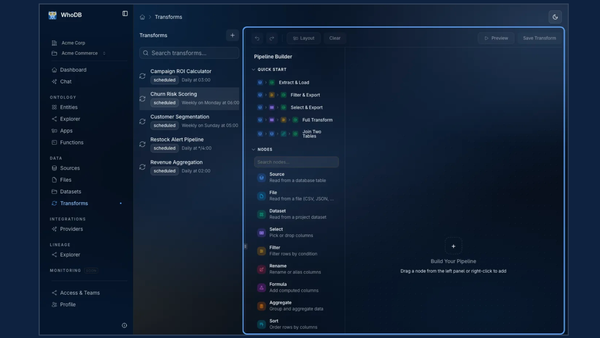
WhoDB connects these two views. Its ontology feature maps business concepts, such as Customer or Order, to the underlying database tables. Teams can explore those relationships through a visual graph, and AI can suggest entities from existing tables.
The lineage view shows how datasets are built and helps teams understand what downstream resources may be affected when a column changes.
This gives teams a way to explore what a business term means and how its data was calculated.
Data leaders can see how this works on the data leaders page, and governance teams can look at the governance view for audit and PII questions. If you're comparing tools, WhoDB also publishes WhoDB vs DataHub and WhoDB vs OpenMetadata.
Semantic Ontology FAQs
What Is a Semantic Ontology in Simple Terms?
A semantic ontology is a structured collection of business terms, their definitions, and the relationships between them. It helps people and software understand business data consistently.
Is a Semantic Ontology the Same as a Data Dictionary?
No. A data dictionary describes database fields and their technical properties. A semantic ontology describes business meaning and the relationships between concepts.
Who Should Own a Semantic Ontology?
Business teams should define the meaning of business terms, while data teams manage the technical implementation. Both groups work together to maintain consistent definitions.
Start With One Shared Definition
A semantic ontology begins with a shared understanding of business terms. Pick one concept your teams define differently, agree on its meaning, and build from there.
To explore how data lineage supports this process, explore WhoDB.