The hidden cost of a fragmented data stack
The hidden cost of a fragmented data stack isn't infrastructure. It's the decisions you never make.

Every company can tell you what its data stack costs. The warehouse bill. The ETL subscription. The BI license. The AI tool everyone signed up for last quarter. It's all there on the invoice.
What doesn't show up is the question nobody asked, because asking it meant waiting three days for an answer that should have taken three minutes. That's the real cost, and it never shows up on a budget line.
The problem: every tool solves one problem; together they create another
Nobody sets out to build a fragmented data stack. It just happens.
One team spins up Snowflake. Another builds dashboards in Power BI. Operations run on SAP. Engineering keeps production data in Postgres. Customer data lives in Salesforce. Marketing brings in its own analytics tool. Each decision was reasonable on its own as it was the right tool for the right job at the right time.
The result, a year or two later, is a business where dozens of systems each hold a slice of the truth, and none of them can see the other slices.
That's not a storage problem. It's a context problem.
Take something as simple as a production defect. The answer to "why did this happen" is rarely sitting in one table. It's spread across a supplier record, a maintenance log, a machine event, an inventory movement, and a quality report. These are five systems that have never spoken to each other. So people become the integration layer instead. Engineers hand-write cross-system queries. Analysts export CSVs and stitch them together in a spreadsheet. Operations waits on a report. By the time the dashboard reaches an executive, the moment to act on it has usually passed.
AI doesn't fix this; it inherits it. A model can only reason over what it can reach. Point an AI assistant at five disconnected databases and three siloed dashboards, and you get an assistant that's just as fragmented as the stack underneath it. It becomes another interface on top of the mess, not a fix for the mess itself.
The solution: one layer that understands how your systems relate
Most companies don't need another warehouse, dashboard, or reporting tool bolted on top of the ones they already have. What's missing is a layer that understands how the existing systems relate to each other.
That's what WhoDB is built to be: an AI-native data platform that goes from raw data to a decision, in one place, self-hosted inside your own infrastructure.
Instead of treating each database as an island, WhoDB connects your sources, builds a shared model of how they relate — machines, batches, suppliers, customers, orders — and lets both people and AI reason over that model directly. A manufacturing engineer doesn't think in tables; they think in machines, shifts, and suppliers. WhoDB lets the data reflect that, instead of forcing everyone to translate business language into SQL every single time.
The outcome isn't a prettier dashboard. It's faster investigations, decisions made with the full picture instead of a fifth of it, and an AI layer that actually understands how your business operates because it's reasoning over connected context and not disconnected tables.
The features: from raw data to decision, in one platform
Here's what that looks like in practice, on app.whodb.com:
- 100+ data source connectors: Postgres, MySQL, MongoDB, Snowflake, ClickHouse, Oracle, MSSQL, and more, plus a universal bridge for everything else, so you're not ripping out systems that already work.
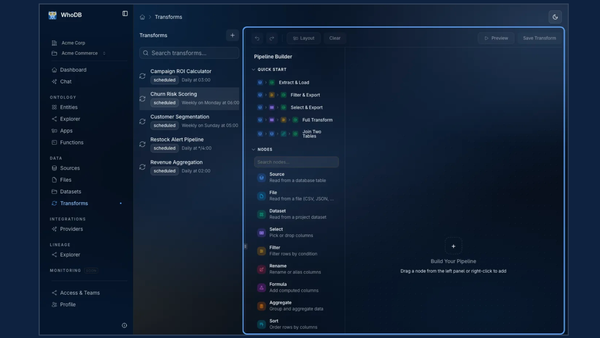
- Visual, no-code ETL builder: drag-and-drop pipelines with AI-assisted transforms, scheduled or event-triggered, with dry-run mode before anything touches production.
- AI-powered semantic ontology: a knowledge graph that maps business concepts (customer, order, batch, machine) to the technical tables underneath them, so new team members and the AI are productive in hours instead of months.
- Governed, managed datasets: schema-on-write contracts, PII and confidentiality markings, and full lineage tracking from source to dataset to decision.
- Serverless functions: write Python or JavaScript that runs directly against your ontology, calls AI models, and powers custom logic, fully audited.
- Decision interfaces, built by AI: ask a business question in plain English and get back a live dashboard, chart, or tool, not just a static report.
- The WhoDB Agent: a conversational layer that connects sources, builds pipelines, and creates ontology on its own, so the path from question to answer doesn't run through an engineering ticket.
- End-to-end lineage and enterprise governance: SSO, granular access control, and a complete audit trail, deployable in your own VPC, air-gapped if you need it.
The takeaway
Companies that move faster over the next decade won't be the ones with the biggest data teams or the largest AI budgets. They'll be the ones with the fewest gaps between information and decisions.
Fixing that isn't about collecting more data. It's about connecting the data you already have, so every decision starts from a shared, trusted picture instead of five disconnected ones.
Try WhoDB at app.whodb.com and connect your first source in minutes.